
Tag Archives: USA

Cost of fracking simply too high

The debate about onshore gas extraction often becomes a debate about scientific measurements and facts, safety and risks. But to understand why gas mining is such a bad lousy and undesirable way to produce energy, you must first have a clearer picture of what the alternative to gas is: Renewable energy. The advantages of renewables are just as important to bring into the debate as the disadvantages of the unconventional gas production.


Dr Anthony Ingraffea does just that in this presentation, where he focuses on the methane leakage in the unconventional gas extraction method and on the move to renewables.

“When the dust clears and the science is done, somewhere around five and six percent of all the natural gas that is produced today never gets burned, it gets vented. And that is really bad for climate change.”

» The slides he shows can be seen here (though in different order): Ingraffea_NYS_Green_Building_Conference_march_2014.pdf
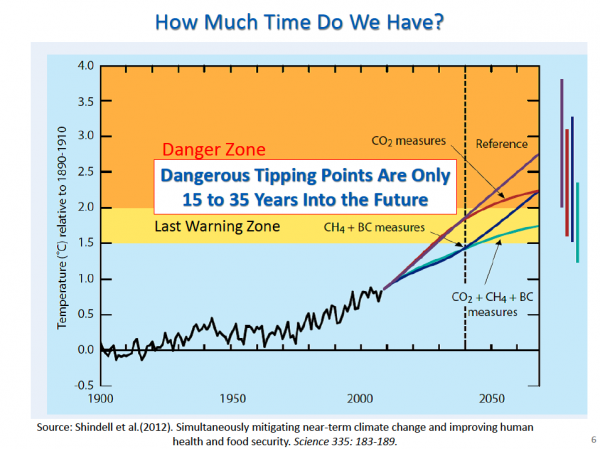

how much time do we have

When all environmental and human costs are included, the cost of fracking is simply too high, explains Dr Anthony Ingraffea. He not only talks about the local effect on water, the health repercussions and the global effect on the climate, he also goes in depth with what an alternative vision to New York’s energy future would look like. And why it makes better sense economically.

Dr Anthony Ingraffea asks for a rational cost-benefit analysis of onshore gas extraction.
“Let’s talk about risk,” he says: “Accidents will happen. How do you cost the risk?”

According to Anthony Ingraffea, rejecting onshore gas extraction is about moving renewables faster to relay climate change. He explains what could be an alternative to shale gas for New York State, how New York could run on 10 percent (4,000) onshore wind turbines, 40 percent (12,000) offshore wind turbines, 10 percent concentrated solar, 10 percent solar PV plants, 6 percent residential rooftops, 12 percent commercial government rooftops, 5 percent geothermal, 0.5 percent wave, 1 percent tidal and 5.5 percent hydro.

“We will be an all electricity state. This can be done. And it will create roughly 58,000 permanent fulltime jobs. Reduce airpollution mortality. 4,000 people in New York die from air emissions.
Now you are sitting there saying, ‘Hey, wait a minute! That is the heck of a lot of work!’
Compared to what?
50.000 to 100.000 wells? That is the hell of a lot of work! 8.000 to 16.000 pads? That is a lot of cement, concrete, a lot of earth moving, a lot of CO2. 500 to 1,000 compressor stations? Thousands of miles of new pipelines, thousands of incidents of well water contamination, increase of New York’s contribution to global warming… and this is the kicker: a hundred tons of steel per well, and once they put it down there, it is gone forever. Whereas anything you build on the surface is recyclable.”

“Renewables will stabilize energy prices and improve energy security. We own the wind, the sun, the water. Their fuel cost is zero. It is cost effective. The $486 billion price tag is paid off entirely in health-cost and climate-cost savings of $36 billion per year over 14 years. Emission decreases would reduce 2050 climate costs by billions of dollars per year.”


Dr Anthony Ingraffea argueed against the proposition that “New York State and/or Starkey Township should allow High Volume Shale Gas Extraction” at a debate sponsored by the Town of Starkey held on 23 January 2013 at the high school auditorium in Dundee, New York, USA.


Dryden – the small town that changed the fracking game

Inspirational 10-minute video – important for all citizens in farmlands, villages and cities of the world. Watch it. Share it.


As this video shows, there are other ways to move forward than through politicians and the media – and they start in our own street, in our own neighbourhood – they start with ourselves, our families and our neighbours.

The story which is being told in this video from the United States is similarly taking place in hundreds of other cities and residential areas in Australia. This is something that takes place wherever the fracking industry pushes forward – and there are many examples of successful results: It IS actually possible to keep the gas industry out of the way, to put a lock on the gate and say: NOT HERE IN OUR COMMUNITY.

But it is a waste of time and energy to start knocking media and politicians on the doors. The way things work these days, we must – and we are indeed able to – for a moment completely to let the media and the politicians out of the picture.

They do not understand what’s going on or what is at stake – and they are too busy with their self-indulgent navel-gazing and short-term economic prospects to take an interest in what the consequences are. They’ll wake up eventually, but only when you and I, the concerned citizens, have managed to create the change and the popular movement that is needed.

So instead, work from ground up: with Facebook, emailing, letterboxing and meetings, go door to door and talk with your neighbours. It starts there.

You might, for example, knock at your closest neighbour’s door today and invite her/him/them over to take look at this video. It takes just 10 minutes – and then you are engaged and moving forward with this. The journey has begun, and it won’t stop until we have a permanent ban on fracking in our region.

. . . . . . . . . . . . . . . . . . . . . . . . . . . . . . . . . .

Lee Ziesche, Gasland Grassroots Coordinator, wrote:

“It’s rare you watch a video and think “wow that’s what democracy looks like” but that’s what I thought when I saw this Earthjustice video. And it’s exactly why we want to share it with you today, as our video of the week.

Watch Our Video of the Week: Dryden – The Small Town that Changed the Fracking Game

Through good old fashioned organizing like neighbor talking to neighbor, and a great legal team in Community Environmental Legal Defense Fund, the citizen’s of Dryden were able to take democracy back and ban fracking.

I was a field organizer on the 2012 Obama Campaign, and while I’m often deeply upset about the administration’s view on fracking, I’m still grateful I was apart of the campaign because I learned a powerful lesson that has guided my work ever since. And it came straight from the President himself.

On a nationwide staff call leading up to Election Day Barack President said, “I still believe that neighbor talking to neighbor is worth more than any amount of corporate spending. “

That sentence sums everything I believe about the anti-fracking movement.

The citizens of Dryden have proven the President’s words to be true. Dozens of other communities across the world, who have passed bans or moratoria, have proven his words to be true. And even those who couldn’t keep fracking out, but now know new neighbors or have become activist for the first time are proving his words to be true.

The industry wants people to feel isolated, like they have no choice but to sign a lease. They want to fracture communities and stay in control.

But if we get organized and talk to our neighbors, we can build something they can’t buy.

I hope this video inspires you as much as it did me to keep up the fight. We are truly building something worth more than any corporation’s yearly profits.

Please watch and share tour video of the week with your community.

What you’re doing is democracy at work.

Thanks and have a great weekend,

Lee Ziesche, Gasland Grassroots Coordinator”

» www.blog.gaslandthemovie.com/?p=610


USA: Breakthroughs on fracking

“People should see and hear the truth before they find themselves living next door to dirty drilling.”

Martin Sheen’s Breakthroughs program on PBS television recently released an expose on fracking featuring Environment America. As the debate over dirty drilling continues to mount, the Breakthroughs piece could reach as many as 60 million viewers in all 50 states.

“Fracking is taking a terrible toll on our environment and our health,” said John Rumpler, senior attorney for Environment America. “People should see and hear the truth before they find themselves living next door to dirty drilling.”

Shot on location in Pennsylvania – epicenter of the fracking frenzy.


» Read more:
www.livinggreenmag.com